
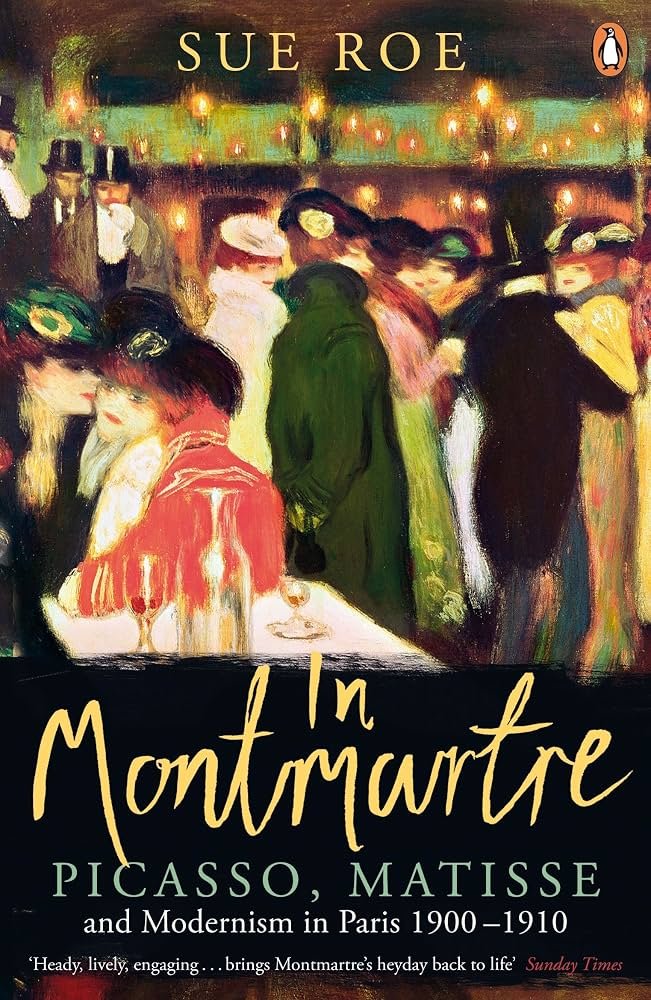
FOMO (Fear of Missing Out) is a twenty first century concept, born of social media’s oversharing revolution. I experienced FOMO recently, the FOMO of not being in Montmartre at the turn of the twentieth century. Montmartre established itself as the centre of the artistic world, the birthplace of the modernist movement. Sue Roe takes one on a journey through this artistic haven between 1900 to 1910, creating an unsurpassable FOMO.
The book centres itself around the journey of Matisse and Picasso, who first met as struggling artists in Montmartre. Despite their shared profession, a division quickly formed between the two. They closely watched each other’s work but as observers, not compatriots. In 1907 they even exchanged paintings - deliberately choosing their worst pieces. Matisse saw success first, starting an animosity that only grew with Picasso’s later success. They were also separated by style. Matisse led fauvism, whilst Picasso established cubism.
Roe describes the dramatic fauvist movement, led by Henri Matisse, Andre Derain, and Maurice de Vlaminck. The name was given by art critic Louis Vauxcelles at the 1905 Salon d’Automne - its breakout exhibition. The name lends itself to the French word fauves, meaning wild beasts, a reference to the bold use of colour. The three embraced the fauvist style as a rejection of photography, breaking away from a snapshot of life so that ‘colours became charges of dynamite.’
Alongside this, Picasso’s cubist movement emerged. Roe presents perspective as the foundation of cubism. Picasso and (his close friend) Braque intended to present the different perspectives one can view an object, showing the transition of time and light. Braque also developed cubism with a focus on geometry, painting still life’s unlike Picasso’s focus on human life. Picasso’s Les Desmoiselles d’Avignon is mentioned as being particularly controversial. Many were confused by this painting of five nude women, broken into different angles of the human body.
Roe’s title alludes to the other modernist artists that emerged in the period. Modigliani’s arrival in Paris is presented as momentous. Viewed as an alternative Italian, he was a subversion to the Montmartre artistic scene, not aligning with either of the two emerging movements. Rousseau’s artistic career was similarly subversive. Disparagingly called by the others le douanier (the customs official), he only began painting towards the end of his life. Initially a struggling retiree, his work was ridiculed until his last few years, when he experienced modest success. His art highlighted the primitiveness of the natural world, transporting one to a world of imagination.
America is currently the origin of much of the world’s extreme wealth. This was true in the early twentieth century as well. The major family of art collectors was the Steins, expatriates from the US. The Steins in Paris consisted of the siblings Leo, Gertrude, and Michael with his wife Sarah. The family hosted Saturday dinner parties, dining with and purchasing work from the likes of Picasso, Matisse, Poiret, Braque, and Vlaminck. The conflict between Picasso and Matisse existed within the family. Gertrude Stein was one of Picasso’s most loyal supporters with a relationship that went beyond the financial. Picasso even completed a Portrait of Gertrude Stein in 1906, now housed at the Met. Conversely, Leo favoured Matisse, being one of his most prominent patrons. The Steins’ art collection evokes jealousy in the reader with their ownership of some of Montmartre’s finest works.
Roe dedicates many pages to the other driving forces of Paris’s modernist movement. Paul Poiret was the pioneer of the haute couture modernist movement. His work was seen as art, even being exhibited at 10 Downing Street. Sergei Diaghilev’s introduction of Les Ballets Russes is described as having a similarly prodigious effect. Its premiere in 1909 caused a tidal wave amidst the Parisian artistic scene. Ballet became synonymous with artwork as the Parisian elite flocked to see the amazing dancers. Its costume designer Leon Bakst became a celebrity, attracting the likes of Picasso and Matisse to design sets.
Roe’s book is well worth a read. She transports one to early twentieth-century Paris, placing them amongst the modern age’s greatest artists. She litters the book with quotes from their lives, painting far more than a portrait of these figures.