
Americans abroad: Teachings from the US armed forces in Britain after the Second World War
The USA was undeniably the leading global power after World War 2. This status had to be defended with military bases across its allied nations. At the gateway to Europe, Britain was central to America’s overseas military operations. These bases were fundamental projections of the post-war USA, highlighting its key social, economic, and scientific characteristics.
US bases abroad were very American. They were bigger and better than anyone else’s, whether that be infrastructure or the number of soldiers. To call them bases undermines their size; perhaps a town is a more fitting description. They fostered huge economic activity, revitalising broken postwar economies. RAF Burtonwood in Warrington, Lancashire, reaped these benefits for the surrounding area of North West England. Despite being an RAF base, by the end of the war it hosted 18,000 American servicemen and American operations continued until its closure in 1991. The ‘Burtonwood Beacon’ reported that between June 1956 and June 1957, £7.5 million (unadjusted for inflation) was spent on the local community. Another £1 million was spent on construction, boosting the North West’s post-war economy. Interestingly, this burst, along with the presence of American soldiers, was argued to be a catalyst for Liverpool’s flourishing post-war music scene. A clear parallel can be made to the economic impact of US military bases on Okinawa, Japan. The USA occupied the islands effectively as a military base after WW2, employing 15% of Okinawans. As with Britain, the economic benefit still remains, but was of particular importance after the War. The surrounding area of many bases had faced an unprecedented level of destruction during the War. Its bases thus mirrored the USA’s post-war economic boom, helping to revive Britain after the devastation of the Second World War.
The political standards of the US army after WW2 were perhaps the biggest deviation from British society. Until 1948, racial segregation was enforced on US military bases despite it not being the law or common practice in Britain. This division provoked the 1943 Battle of Bamber Bridge, an armed battle between African American and White US soldiers in Lancashire. The Ye Olde Hob Inn pub of Bamber Bridge regularly hosted both groups of troops. The Lancastrians resisted the Americans’ demands for the segregation of the pub, welcoming the African American soldiers. However, the dissatisfaction of the White American soldiers led to an armed battle on the evening of the 24th between the two groups, leading to one death. The harsh segregation and discrimination of African Americans were unfortunately characteristic of US politics after the War, legally enshrined by the 1896 ruling of Plessy vs Ferguson. This extended to its military bases in the UK, highlighting a key social and political difference between the UK and USA.
The UK was at the heart of the USA’s nuclear weapons dilemma. The controversy surrounding atomic weapons was unusually ignited in the Pacific Marshall Islands. The US chose the islands for nuclear testing, relocating its native population and destroying the islands’ habitat. Many became fearful of these rapidly developing tests that aimed to enhance destruction. The human cost was also recognised. The Lucky Dragon fishing ship of Japan was struck by the nuclear fallout from a test on the Atoll, leading to lifelong health problems for its workers. This contributed to the significant resistance to US nuclear weapons in the UK. The Campaign for Nuclear Disarmament was founded in 1957, championing theology, philosophy, and politics for nuclear disarmament. The movement’s logo became the peace sign. Gerald Holtom designed it based on the semaphore signs of N and D, standing for Nuclear Disarmament. A key aim of the CND was the removal of nuclear weapons from US Air Force bases in Britain. This aim led to its largest march on 22 October 1983, with over 400,000 demonstrating against the US missiles in Britain. The CND became a significant political force in the UK in the 1980s, campaigning against the USA’s major modern scientific innovation, the defining feature of the last century’s military technology. The central opposition to this element of US military bases resembled the burgeoning conflict between science and nuclear safety.
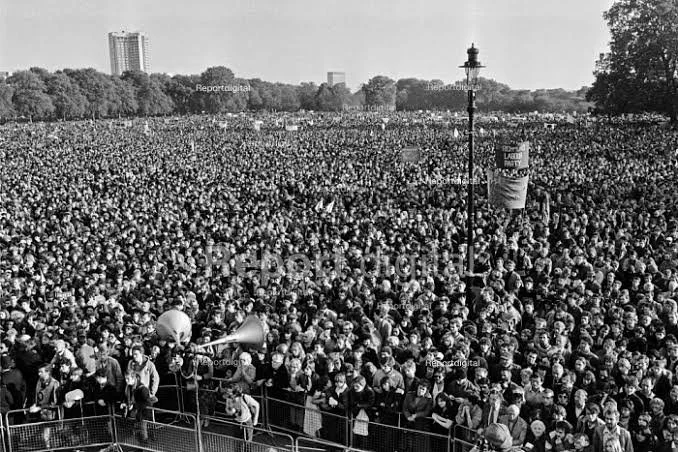
CND march in Hyde Park, London, 22 October 1983
These are a few examples of the myriad of teachings from the post-war US military bases in Britain. The inclusion of the previous three highlights the defining economic, political and scientific characteristics of the post-war USA, a contrast with British society.
- John Gartside